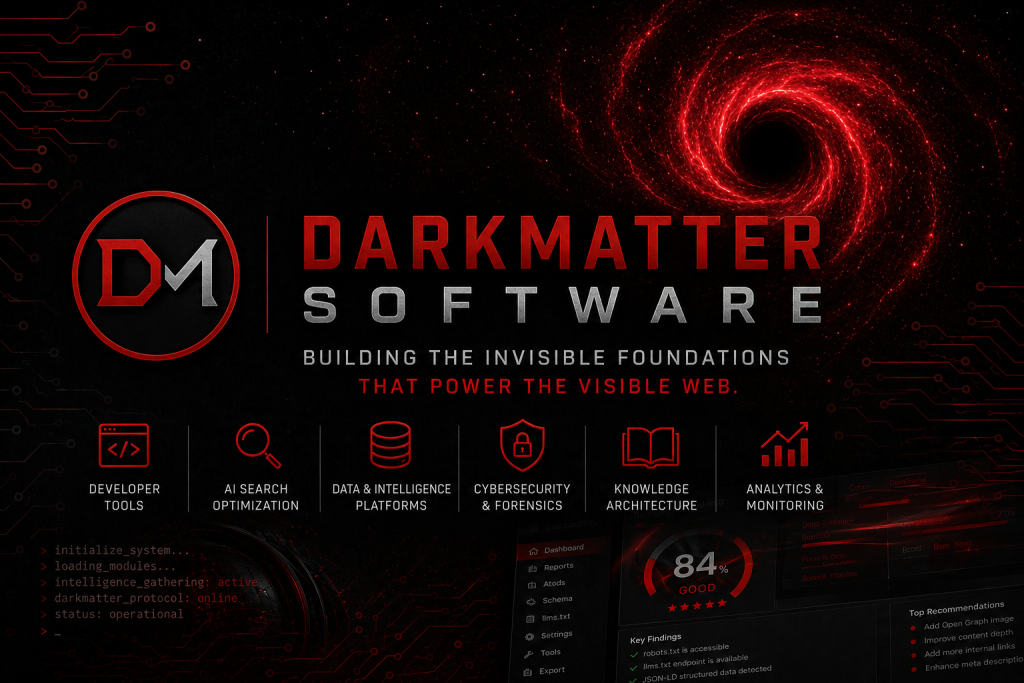

DarkMatter Software Development
Engineering Purpose-Built Software for Intelligence, Research, Automation, and Discovery
DarkMatter Software is an independent software development initiative dedicated to building practical, intelligent, and highly specialized applications that solve real-world technical problems. Rather than focusing on mass-market consumer software, DarkMatter develops purpose-built systems designed for professionals, researchers, developers, engineers, investigators, enthusiasts, and organizations that require precision, flexibility, and complete control over their tools.
At its core, DarkMatter represents curiosity, technical excellence, disciplined engineering, and the relentless pursuit of knowledge. Every application is designed with the philosophy that software should empower its user rather than limit them.
Our Philosophy
Technology should be transparent.
Software should respect the user.
Data should belong to the people who create it.
Knowledge should be organized.
Automation should remove repetitive work while preserving human decision making.
DarkMatter applications are designed around these principles.
Instead of producing bloated software filled with unnecessary features, DarkMatter emphasizes efficient architecture, clean interfaces, portability, reliability, and long-term maintainability.
Every release is intended to become a dependable tool that users can trust for years.
Areas of Software Development
DarkMatter develops software across numerous technical disciplines.
Desktop Applications
Cross-platform desktop software for:
- Windows
- Linux
- macOS
Many applications are self-contained, portable, and require minimal installation while remaining fully featured.
Examples include:
- Development utilities
- Database managers
- Image processing software
- Engineering tools
- Productivity software
- Scientific utilities
- AI frontends
- Security applications
- System administration tools
Artificial Intelligence
Artificial Intelligence is one of the primary focuses of DarkMatter development.
Rather than replacing human expertise, AI is viewed as an intelligent assistant capable of accelerating research, automating repetitive analysis, organizing information, and identifying patterns that may otherwise remain hidden.
Current areas include:
- Large Language Model integration
- Local AI deployment
- AI-assisted software development
- Machine identity systems
- Knowledge graph generation
- Automated research
- Intelligent search
- Natural language interfaces
- AI workflow automation
- Entity extraction
- Relationship mapping
- AI search optimization
- Retrieval systems
- Semantic analysis
DarkMatter strongly supports locally hosted AI whenever possible, giving users complete ownership of their data.
Knowledge Management
A recurring theme throughout many DarkMatter applications is the organization of knowledge.
Information should not simply be stored.
It should be understood.
Applications are designed to collect, organize, connect, search, analyze, and visualize information in ways that improve decision making.
This includes:
- Knowledge trees
- Entity databases
- Relationship graphs
- Research archives
- Citation systems
- Metadata extraction
- Search indexing
- AI-assisted categorization
Cyber Intelligence & Reconnaissance
DarkMatter develops tools that assist in understanding digital environments.
These applications focus on observation, diagnostics, logging, and intelligence gathering.
Capabilities include:
- Website reconnaissance
- HTTP analysis
- User-Agent analysis
- Metadata inspection
- Web crawling
- Directory discovery
- HTML structural analysis
- Network diagnostics
- Log analysis
- Threat observation
- Honeypot technologies
- Search engine research
- Performance auditing
These tools are intended for legitimate defensive research, diagnostics, education, and infrastructure analysis.
Engineering & Simulation
DarkMatter also develops engineering software capable of assisting technical design and simulation.
These applications emphasize accuracy, repeatability, and experimentation.
Current development areas include:
- Mechanical design
- Engine simulation
- Vehicle modeling
- Performance estimation
- Parts databases
- Technical calculations
- Component compatibility
- Manufacturing documentation
Database Applications
Many DarkMatter products are built around efficient database design.
Supported technologies include:
- SQLite
- MySQL
- MariaDB
- PostgreSQL
- JSON databases
Applications often feature:
- Automatic backups
- Import and export
- Database administration
- Search
- Reporting
- Versioning
- Portable deployment
SQLite remains a preferred solution for many standalone desktop applications due to its simplicity, reliability, and portability.
Web Technologies
DarkMatter develops complete web applications ranging from small utilities to complex management systems.
These include:
- Administrative dashboards
- Content management tools
- Research platforms
- AI interfaces
- Analytics systems
- REST APIs
- Custom dashboards
- Web services
- Authentication systems
- Database management interfaces
Applications are typically self-hosted, allowing organizations to retain complete ownership of their infrastructure.
WordPress Development
DarkMatter actively develops advanced WordPress technologies including:
- Plugins
- Themes
- AI integrations
- Search optimization
- Administrative tools
- Security enhancements
- SEO automation
- AEO (AI Engine Optimization)
- Structured data generation
- Machine-readable publishing
The objective is to prepare websites not only for human visitors but also for the rapidly evolving ecosystem of AI search engines and intelligent assistants.
Automation
Automation is woven throughout the DarkMatter ecosystem.
Applications are designed to reduce repetitive work while maintaining complete transparency over every automated action.
Examples include:
- Data processing
- File conversion
- Scheduled tasks
- Content generation
- Metadata extraction
- Database maintenance
- Research automation
- Report generation
- AI-assisted workflows
Privacy First
DarkMatter strongly favors local execution.
Many applications are capable of operating entirely offline without transmitting user data to third-party services.
Benefits include:
- Improved privacy
- Faster performance
- No subscription dependency
- Greater reliability
- Complete data ownership
- Long-term accessibility
Supported Technologies
DarkMatter products are built using modern, proven technologies.
Programming Languages
- Python
- PHP
- Go
- JavaScript
- TypeScript
- SQL
- Bash
- HTML5
- CSS3
- JSON
Additional languages and frameworks are incorporated whenever they provide measurable advantages for a particular project.
Frameworks & Libraries
Examples include:
- Tkinter
- Flask
- Bootstrap
- PDO
- SQLite
- Apache
- Nginx
- REST APIs
- Playwright
- PyInstaller
Supported Platforms
DarkMatter applications target:
- Linux
- Windows
- macOS
Many projects are portable and designed to execute with minimal system requirements.
Project Categories
The DarkMatter ecosystem currently spans numerous categories of software.
These include:
- Artificial Intelligence
- Desktop Utilities
- Developer Tools
- Engineering Software
- Database Applications
- Knowledge Management
- Web Crawlers
- Website Analysis
- Search Intelligence
- WordPress Plugins
- WordPress Themes
- Automation Platforms
- Research Utilities
- System Administration
- Image Processing
- Metadata Analysis
- Digital Forensics
- Logging Systems
- Network Utilities
- Monitoring Systems
- Security Research
- Information Retrieval
- Technical Documentation
Brand Ecosystem
DarkMatter software is supported by a growing family of specialized products and technologies.
Representative projects include:
- MechSpec
- FlexHost
- HTTPXRay
- ANT
- Xerxes
- OAK
- Hummingbird
- Apple Pie Image Converter
- DarkMatter AEO
- UAForge
- GeoIP Forensics Console
- TagCrawler
- JuggerBot
- Weather Or Knot
Each application focuses on solving a specific technical problem while sharing a common design philosophy centered on portability, usability, and engineering discipline.
Design Philosophy
DarkMatter interfaces embrace a distinctive visual identity inspired by professional operations centers, engineering workstations, and technical laboratories.
Common characteristics include:
- Dark themes
- High contrast interfaces
- Minimal distractions
- Functional layouts
- Efficient workflows
- Keyboard accessibility
- Information density where appropriate
- Consistent visual language
The goal is to maximize productivity rather than decoration.
Looking Forward
The future of DarkMatter Software extends beyond standalone applications.
Ongoing development includes expanding artificial intelligence capabilities, knowledge graph technologies, autonomous research systems, distributed software ecosystems, machine-readable publishing, and next-generation developer tools.
As artificial intelligence becomes increasingly integrated into everyday computing, DarkMatter remains committed to building software that enhances human capability rather than replacing it.
What DarkMatter Represents
DarkMatter is more than a software label.
It represents an engineering philosophy built on curiosity, technical integrity, continuous learning, and purposeful innovation.
It is the belief that software should illuminate complexity rather than obscure it.
It is the pursuit of practical intelligence over unnecessary complexity.
It is disciplined development, thoughtful automation, respect for user ownership, and a commitment to creating tools that remain useful long after trends have passed.
Every application bearing the DarkMatter name is built with a single objective:
To transform information into understanding, automation into productivity, and technology into a reliable extension of human capability.
"Every man is guilty of all the good he did not do."
Voltaire